What Is an Inline Homogenizer?
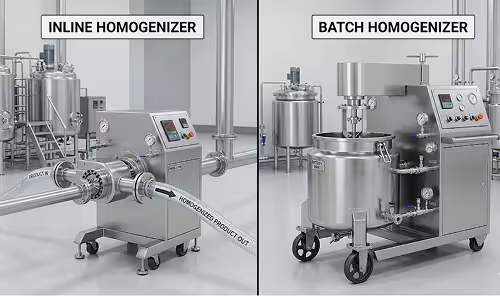
An inline homogenizer (also called a continuous homogenizer) is installed directly in the production pipeline. Milk flows through it continuously — entering the pump, passing through the homogenization valve at 150–250 kg/cm², and exiting as homogenised product without any stop-start cycle.
All SEW TITAN Series homogenizers are inline (continuous) units designed for direct integration into dairy production pipelines, including HTST pasteurisation lines.
What Is a Batch Homogenizer?
A batch homogenizer processes a fixed volume of product at a time. The batch is loaded, homogenised, and discharged before the next cycle begins. In practice, most true batch homogenizers are small-scale or laboratory units. The term is sometimes incorrectly applied to high-shear mixers used in batch production sequences.
Key Differences
| Parameter | Inline Homogenizer | Batch Mode |
|---|---|---|
| Process flow | Continuous | Discontinuous |
| Throughput | 100–5,000 LPH | Low to medium |
| Pressure | Up to 200+ bar | Typically lower |
| Fat globule consistency | Uniform across full run | Variable between batches |
| CIP compatibility | Yes (full CIP circuit) | Usually manual cleaning |
| IS 13688 compliance | Standard | Depends on design |
| Suitable for | Commercial dairy, FMCG | R&D, trials, small-scale |
High Shear Mixer vs Homogenizer: Are They the Same?
No. A high-shear mixer uses a rotor-stator mechanism at relatively low pressure to blend and emulsify. A high-pressure plunger homogenizer forces liquid through a narrow valve at 150–250 kg/cm², achieving sub-micron fat globule reduction not possible with a mixer.
| Feature | High-Pressure Homogenizer | High Shear Mixer |
|---|---|---|
| Mechanism | Pressure differential through valve | Rotor-stator mechanical shear |
| Droplet size achieved | Sub-micron (0.1–1 µm) | 1–10 µm |
| IS 13688 compliance | Yes (applicable standard) | Not applicable |
| For commercial dairy milk | Required | Not a substitute |
Which Should You Choose for Your Dairy or Ice Cream Plant?
For any commercial dairy plant processing 500 LPH or more:
- Choose an inline high-pressure homogenizer (SEW TITAN Series)
- Specify 2-stage homogenisation for standard pasteurised milk
- Size the unit at 10–15% above your current peak daily volume to allow for growth
- Confirm SS 316 liquid-contact parts if processing acidified products or using aggressive CIP chemicals
For small-scale trials or R&D (below 100–200 LPH), a lab-scale batch unit may be appropriate. Contact SEW to discuss the right equipment for your specific application and volume.
Sizing Guide
| Daily Production (LPD) | Effective Processing Hours | Min. Homogenizer Size |
|---|---|---|
| 1,000 LPD | 6 hrs | ~170 LPH → 200 LPH unit |
| 3,000 LPD | 6 hrs | ~500 LPH unit |
| 6,000 LPD | 6 hrs | ~1,000 LPH unit |
| 15,000 LPD | 6 hrs | ~2,500 LPH unit |
Frequently Asked Questions
Can I use a high shear mixer instead of a homogenizer for milk?
No. A high shear mixer cannot achieve the fat globule reduction (less than 1 µm) required for commercially homogenised milk as per IS 13688. FSSAI-regulated dairy plants require a true high-pressure plunger homogenizer for this process.
What is the minimum homogenizer size for a 500 LPD ice cream plant?
A 500 LPH homogenizer (SEW TITAN SHM-500, 7.5 HP) handles your full daily volume in one hour — well within a single shift. This is the standard specification for a 500-litre-per-day ice cream plant.
Does SEW supply both 1-stage and 2-stage homogenizers?
Yes. SEW TITAN Series is available in 1-stage and 2-stage configurations with manual or automatic pressure adjustment. For standard pasteurised milk and ice cream, 2-stage is recommended.
How do I integrate an inline homogenizer with my existing pasteurisation line?
The homogenizer is typically installed between the pre-heating section and the holding tube in an HTST line, or after the pasteuriser in a batch system. SEW's application engineer will confirm the correct integration point for your specific line layout before order.