← Back to Resource Hub

Energy-Efficient Homogenizer — Power Consumption, Cost & What to Specify

This guide covers homogenizer power consumption for Indian plants, how to calculate energy cost per litre, what drives inefficiency (oversizing, worn valves, excess pressure), and what to specify when buying an energy-efficient homogenizer. Includes Titan Series power data from SEW.
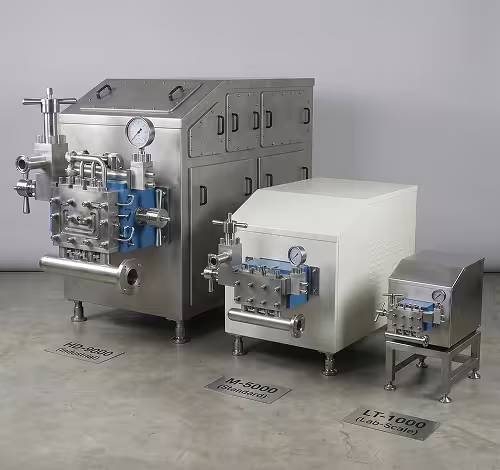
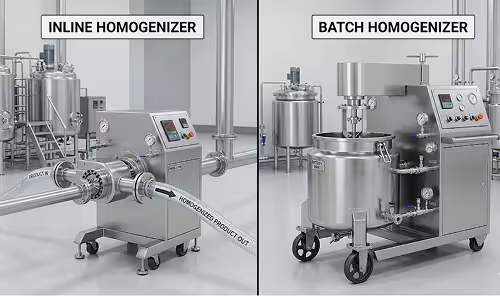
Energy-efficient homogenizer guide for plant managers

Energy-Efficient Homogenizer — Power Consumption, Cost & What to Specify

For a 5,000 LPH dairy plant running 16 hours/day, a homogenizer consuming 37 kW instead of 30 kW costs ₹2.5–3 lakh extra per year in electricity alone. Multiply that over 10 years of machine life and the “cheaper” homogenizer was never cheap. This guide shows Indian plant managers how to calculate homogenizer energy cost, identify what drives inefficiency, and what to specify when buying an energy-efficient unit.

TLDR — Key Takeaways:

How Homogenizer Power Consumption Works

Homogenizer power consumption follows a simple formula:

Power (kW) = Flow (LPH) × Pressure (bar) ÷ 3,600 ÷ Pump Efficiency

Example: 5,000 LPH at 200 bar at 80% pump efficiency:

5,000 × 200 ÷ 3,600 ÷ 0.80 = 34.7 kW

Same machine at 85% efficiency = 32.7 kW. Over 16 hr/day at ₹8/kWh, that 2 kW difference = ₹93,000/year. Pump efficiency is the single biggest variable under the manufacturer’s control.

5 Things That Make a Homogenizer Energy-Inefficient

1. Oversizing Capacity

A homogenizer sized at 10,000 LPH running a 5,000 LPH line is operating at 50% flow. Reciprocating pump efficiency drops sharply at part load. Motor runs at full rated power regardless of throughput. Result: you pay for 10,000 LPH and get the efficiency of 5,000 LPH. Rule: size at 110–120% of peak — never 200%.

2. Specifying Excess Pressure

Every additional 50 bar adds ~12–15% to energy cost. Standard milk homogenization at 200 bar achieves all required fat globule reduction. Running at 300 bar for “good measure” wastes energy, accelerates valve wear, and provides no product benefit for standard dairy. Match pressure to product requirement.

3. Worn Homogenizing Valve

A worn homogenizing valve (seat erosion, valve face wear) requires higher pressure to achieve the same particle size. If a plant used to run at 180 bar and now needs 230 bar for the same result — the valve is worn. 50 bar extra = 25–30% more energy. Replace valve kits on schedule, not when the machine fails.

4. Wrong Motor Sizing

An oversized motor running at 50–60% load has a power factor of 0.6–0.7 vs 0.85–0.9 at full load. Low power factor = penalty charges on Indian electricity bills (many DISCOMs charge power factor surcharge below PF 0.9). Match motor kW to actual hydraulic power requirement plus 10–15% margin.

5. Poor Mechanical Efficiency — Cheap Crankshaft & Bearings

Mechanical losses in the crankshaft, connecting rod bearings, and crosshead convert electrical energy to heat instead of hydraulic pressure. Well-machined precision crankshafts and properly specified bearings reduce mechanical losses by 3–5 percentage points of efficiency. Over 10 years, that gap accumulates to significant cost.

How to Evaluate Energy Efficiency When Buying a Homogenizer

1. Ask for guaranteed pump efficiency at duty point. A reputable manufacturer will specify pump efficiency (%) at your operating flow and pressure. Reject offers that only state motor kW without pump efficiency.

2. Calculate energy cost per litre at your duty point. Use: Power (kW) ÷ Flow (LPH) = kW per LPH. Multiply by your electricity tariff to get ₹ per 1,000 litres processed. Compare between suppliers using the same flow and pressure.

3. Ask about valve kit replacement interval. Shorter replacement interval = valve wears faster = pressure creep = energy waste. Ask for guaranteed valve kit life in hours or litres processed.

4. Check motor specification. IE3 (Premium Efficiency) motors are now mandatory for new industrial motors above 0.75 kW in India (BEE regulation). If a supplier quotes an IE1 or IE2 motor, that is non-compliant and inefficient.

5. Request AMC with performance verification. A good AMC includes a pressure test and flow measurement at each visit. If pressure creep is detected early, you catch valve wear before it becomes energy waste.

SEW Titan Series — Energy Efficiency Features

The Titan Series homogenizer is engineered for efficiency at Indian operating conditions:

For a typical 3,000 LPH dairy plant running at 180 bar, Titan Series consumes approximately 18–20 kW. At ₹8/kWh, 16 hr/day, 300 days/year: electricity cost ₹69,000–77,000/year. A less-efficient homogenizer at 85–90% of that efficiency would cost ₹78,000–86,000/year — a ₹9,000–10,000/year difference for the same production.

Conclusion

Energy efficiency in homogenizers is not a marketing term — it is a specification. The numbers to demand from any supplier: pump efficiency (%), motor IE rating, valve kit life (hours), and guaranteed power at your duty point. These four numbers determine your 10-year electricity cost.

Contact System Engineering Works to get energy calculations for your specific plant:
Phone: +91 9226622716  |  Email: info@systemengg.com

Frequently Asked Questions

Q: How much power does a homogenizer consume in a dairy plant?
A: Power = Flow (LPH) × Pressure (bar) ÷ 3,600 ÷ Pump efficiency. A 3,000 LPH unit at 180 bar and 85% efficiency consumes ~17.6 kW. A 5,000 LPH unit at 200 bar and 85% efficiency consumes ~32.7 kW.

Q: How can I reduce homogenizer energy consumption in my plant?
A: Match operating pressure exactly to product requirement (don’t run at maximum). Replace worn valve kits on schedule (pressure creep = energy waste). Avoid oversizing. Specify IE3 motors. Use an AMC with performance measurement.

Q: What is a good pump efficiency for a homogenizer?
A: 82–87% is achievable with quality manufacturing. Below 75% indicates poor mechanical design or worn internals. Always ask the manufacturer to state guaranteed pump efficiency at your operating duty point.

Q: Does operating pressure affect homogenizer energy cost?
A: Significantly. Every 50 bar increase at constant flow adds ~12–15% to power consumption. Standard dairy milk needs 150–200 bar. Specifying 300 bar for standard milk wastes energy with no product benefit.

Q: How do worn homogenizing valves increase energy cost?
A: Worn valve seats reduce homogenizing efficiency. The operator increases pressure to compensate. 50 bar of pressure creep = 25–30% more energy. Replace valve kits before pressure creep starts, not after.

Q: What motor efficiency rating should I specify for a new homogenizer in India?
A: IE3 (Premium Efficiency) is mandatory for motors above 0.75 kW in India under BEE regulations. Reject any homogenizer offer specifying IE1 or IE2 motors. IE3 reduces motor losses by 20–30% vs IE1.

Have a specific requirement?

Talk to our engineering team. 22 years manufacturing homogenizers and triplex pumps in Nashik, 2,500+ units delivered pan-India.

Request a Quote from SEW

Get a Custom Quote

×
Thank you! Your submission has been received!
Oops! Something went wrong while submitting the form.