What FSSAI Compliance Is Required for Pasteurization and Homogenization Equipment?
FSSAI compliance for pasteurization and homogenization equipment in India requires: FSSAI Schedule 4 hygienic equipment construction (SS 316L, CIP-compatible, smooth surfaces), pasteurizer temperature validation (72°C/15 sec for HTST; 63°C/30 min for batch), and temperature recording with calibrated instruments. Homogenizers must comply with IS 13688 (BIS standard for milk homogenizers). All food processing equipment in FSSAI-licensed dairy plants must meet these standards before commercial operation.
FSSAI Regulatory Framework for Dairy Equipment
Three regulatory layers govern pasteurization and homogenization equipment in India:
- Food Safety and Standards Act, 2006: Mandates pasteurization for packaged market milk sold in India
- FSSAI Food Safety and Standards (Licensing and Registration) Regulations, 2011: Defines equipment and facility requirements for dairy manufacturing licenses
- FSSAI Schedule 4 — Hygienic and Sanitary Practices: Specifies equipment construction materials, surface finishes, cleaning requirements
Schedule 4 Requirements for Processing Equipment
Pasteurizer FSSAI Compliance Requirements
Temperature-Time Standards (FSSAI / IS 1479)
Required Safety Devices on HTST Pasteurizers
- Flow diversion valve (FDV): Automatically diverts under-processed milk back to raw side if temperature drops below 72°C
- Temperature sensor and recorder: Calibrated RTD or thermocouple with continuous chart recorder or digital logger
- Back pressure valve: Ensures pasteurized side always at higher pressure than raw side (prevents cross-contamination)
- Booster pump: Maintains forward flow pressure differential
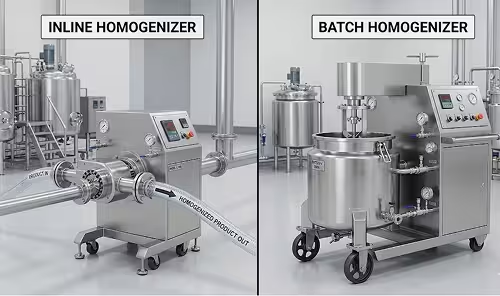
Homogenizer FSSAI & IS 13688 Compliance
IS 13688 is the Bureau of Indian Standards (BIS) specification for milk homogenizers used in dairy plants. Key compliance requirements:
- Pressure rating: Homogenizer must achieve and maintain rated pressure (150–300 bar for dairy) without leakage or pressure drop exceeding 5%
- Material certification: SS 316L material test certificate (MTC) required for all product-contact parts
- Homogenizing valve: Must produce uniform fat globule reduction — <2 µm mean globule size at rated pressure
- Pressure relief valve: Mandatory safety device — set at 110% of rated pressure
- Pressure gauge: Calibrated, glycerine-filled, mounted at pump outlet
- CIP ports: Homogenizer must be cleanable in-place without disassembly of main components
FSSAI License Documentation: Equipment Compliance Evidence
FSSAI licensing officers require documentation proving equipment compliance. For pasteurization and homogenization equipment, prepare:
Common FSSAI Audit Failures and How to Avoid Them
- Temperature recorder not calibrated: NABL-calibrate all temperature sensors annually, maintain calibration certificates on-site
- CIP not documented: Maintain daily CIP log (time, chemical concentration, temperature, duration) for each circuit
- SS grade not verified: Keep material test certificates (MTCs) for all stainless steel components in plant documentation file
- Flow diversion valve not tested: Test FDV response monthly, log results. FSSAI auditors specifically check FDV function
- No pressure relief on homogenizer: Mandatory safety device — must be present and set correctly
Frequently Asked Questions
Is pasteurization mandatory for all milk sold in India?
Yes, under FSS (Food Products Standards and Food Additives) Regulations, 2011, all packaged milk sold in India must be pasteurized. Raw milk may only be sold directly from farmer to consumer at point of production under specific exemptions. Dairy plants supplying packaged milk must have FSSAI-compliant pasteurization equipment.
Does SEW provide IS 13688 compliance documentation for its homogenizers?
Yes. SEW provides material test certificates, IS 13688 compliance declaration, surface finish reports, pressure test certificates, and equipment specifications for each TITAN Series homogenizer. These documents are accepted for FSSAI licensing applications.
What is the difference between FSSAI Schedule 4 and IS 13688?
FSSAI Schedule 4 is a broad hygienic standard covering all food processing equipment — surface materials, finishes, CIP compatibility. IS 13688 is a specific BIS standard for milk homogenizers — covering performance (pressure, fat globule size), safety devices, and material requirements. Both apply to homogenizers in FSSAI-licensed dairy plants.
How often must pasteurizer temperature sensors be calibrated for FSSAI compliance?
FSSAI guidelines recommend annual calibration minimum. For active manufacturing facilities, quarterly calibration is best practice. Calibration must be done by NABL-accredited lab. Calibration certificates must be maintained on-site and presented during FSSAI audits.
Request a Quote from SEW — Contact us for FSSAI-compliant pasteurization and homogenization equipment with full documentation support. We respond within 24 hours.