Which Homogenizer Works for Soya Milk and Plant-Based Beverages?
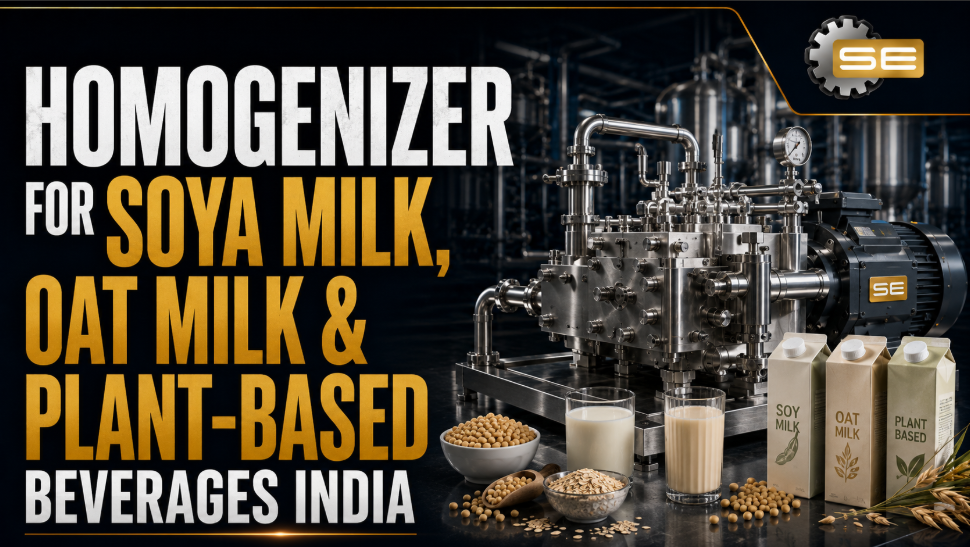
SEW TITAN Series high-pressure homogenizers (500–10,000 LPH) are engineered for plant-based milk processing. Soya milk, oat milk, almond milk, and coconut milk carry suspended fiber particles, proteins, and starches that require homogenization at 150–300 bar to achieve stable emulsions and prevent phase separation.
SEW supplies TITAN Series units to food and beverage processors across Gujarat, Maharashtra, Karnataka, and Tamil Nadu. All units are FSSAI-compliant and stainless steel (SS 316L) contact parts.
Why Plant-Based Milk Needs Different Homogenization Settings
Conventional dairy homogenizers are set for fat globule reduction in cow milk (100–200 bar, 3,500–5,000 PSI). Plant-based milks present different challenges:
- Soya milk: High protein content, beany off-flavor compounds require fine particle reduction at 200–250 bar with two-stage homogenization
- Oat milk: Beta-glucan starch can gel at wrong temperatures — homogenize at 60–70°C, 150–200 bar
- Almond milk: Low total solids, needs fine cell wall rupture at 200–300 bar
- Rice milk: Starch-based, prone to retrogradation — homogenize immediately after cooking
TITAN Series units offer adjustable two-stage homogenizing valves (first stage 75–80%, second stage 20–25% of total pressure). This two-stage configuration produces uniform particle size below 1 micron and extends shelf life by 3–5x versus single-stage.
TITAN Series Models for Plant-Based Processing
Process Integration: Where Homogenizer Fits in Plant-Based Line
Typical soya milk line flow: Soaking → Grinding/Milling → Cooking (85–95°C, 15 min) → Homogenization (80–85°C, 200–250 bar) → Pasteurization (72°C/15s HTST or 85°C/30s batch) → Cooling → Filling.
SEW can supply homogenizer as standalone unit or integrated with pasteurization system. Homogenizer placed before pasteurizer improves HTST plate efficiency by ensuring uniform particle size. Alternatively, placed after pasteurizer for UHT aseptic lines.
India-Specific Compliance
- FSSAI Schedule 4 compliance for food processing equipment
- SS 316L product-contact surfaces with Ra ≤ 0.8 µm finish
- CIP-compatible design (caustic + acid + hot water clean-in-place)
- Suitable for FSSAI-licensed plant-based dairy facilities
Buyer Selection Checklist
- What is your required output in LPH (litres per hour)?
- What raw material: soya, oat, almond, coconut, rice?
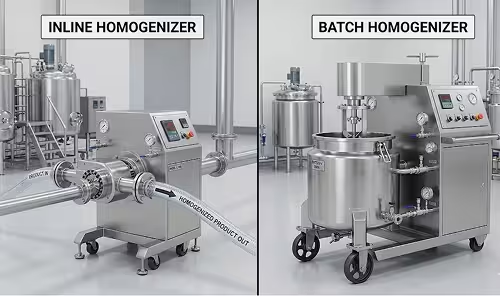
- Do you need inline homogenization (HTST line) or batch mode?
- Do you require two-stage homogenization?
- What is your product target shelf life (ambient, chilled, UHT)?
Frequently Asked Questions
Can I use a dairy homogenizer for soya milk?
Yes, but settings differ. Soya milk requires higher pressure (200–250 bar vs. 150–200 bar for dairy) and two-stage configuration to handle protein aggregation. TITAN Series supports field-adjustable valve settings.
What pressure is needed for oat milk homogenization?
Oat milk processes well at 150–200 bar, two-stage. Higher pressures can cause starch over-shearing. Process temperature: 60–70°C. TITAN 1000–5000 LPH models suitable.
Does SEW supply homogenizers for R&D or pilot plant scale?
Yes. TITAN 500 LPH handles pilot and R&D volumes. Suitable for new product development before scale-up to commercial line.
What cities does SEW serve for plant-based beverage equipment?
SEW supplies and services across Nashik, Pune, Mumbai, Ahmedabad, Vadodara, Bangalore, Chennai, Hyderabad, and Coimbatore. On-site installation and commissioning available nationally.
Request a Quote from SEW — Contact us with your capacity requirement and raw material. We respond within 24 hours.