← Back to Resource Hub

How to Choose the Right Homogenizer for Your Plant — India Buyer's Guide

This guide explains how to choose the right homogenizer for dairy, pharma, beverage, or chemical plants in India. Covers capacity (LPH), operating pressure (bar), inline vs batch, valve type, certifications (IS 13688, API 674), and how to evaluate Indian suppliers.
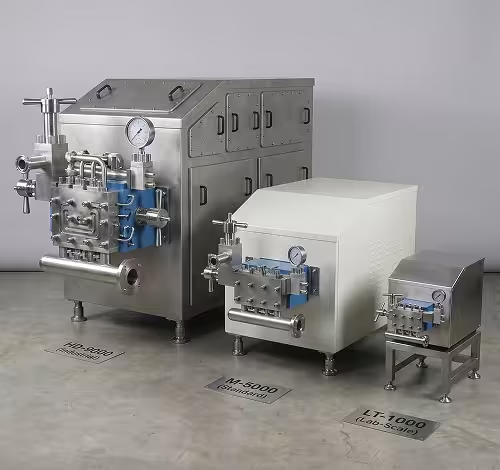
Homogenizer buyers guide for Indian plants

How to Choose the Right Homogenizer for Your Plant — India Buyer’s Guide

Choosing the wrong homogenizer costs more than the price tag. Wrong capacity and you bottleneck your line. Wrong pressure and you get poor particle size reduction. Wrong material and you fail a food safety audit. This guide walks Indian plant engineers and purchase managers through every decision point — so you specify correctly the first time.

TLDR — Key Takeaways:

  • Size by peak line capacity, not average throughput
  • Dairy plants require IS 13688 certification; pharma requires API 674 + cGMP
  • Inline homogenizers suit continuous lines; batch suits R&D and smaller runs
  • Two-stage valves needed for sub-5 µm particle size (pharma, premium dairy)
  • Always request factory test report, pressure certificate, and material traceability before purchase

What Is a Homogenizer and Why It Matters

A homogenizer is a high-pressure pump that forces a liquid through a precision valve assembly at pressures typically between 100 and 600 bar. The sudden pressure drop creates intense turbulence and shear forces that break down fat globules, particles, or droplets to a uniform size. In dairy, this prevents cream separation and improves texture. In pharma, it creates stable emulsions. In beverages, it prevents pulp settling and extends shelf life.

The homogenizer market in India is growing at ~8% annually driven by FSSAI enforcement, the rise of processed dairy, and pharma manufacturing expansion. Getting your specification right determines whether your machine delivers ROI or becomes a maintenance problem.

How to Choose the Right Homogenizer — 5 Key Decisions

Decision 1: Capacity (LPH)

Size your homogenizer at 110–120% of your peak production line speed — not your average throughput. If your pasteurizer runs at 5,000 LPH peak, specify a 5,500–6,000 LPH homogenizer. Undersizing forces the homogenizer to run at 100% continuously, accelerating seal and valve wear. Common Indian dairy plant sizes: 500 LPH (small cooperative), 2,000–5,000 LPH (mid-tier processor), 10,000+ LPH (large cooperative or MNC).

Plant ScaleTypical CapacityHomogenizer Size
Small cooperative / artisanUp to 1,000 LPH500–1,200 LPH
Mid-tier processor1,000–5,000 LPH2,000–6,000 LPH
Large dairy / MNC5,000–15,000 LPH6,000–18,000 LPH

Decision 2: Operating Pressure (Bar)

Higher pressure = smaller particle size = better homogenization — but also higher energy cost and faster wear. Match pressure to your product requirement, not to the maximum available.

ApplicationTypical Pressure Range
Standard dairy (toned/full-fat milk)150–200 bar
UHT/long-life dairy200–300 bar
Beverage homogenization100–250 bar
Pharma emulsion (single-stage)200–400 bar
Pharma emulsion (sub-micron/injectable)400–600 bar

Decision 3: Inline vs Batch

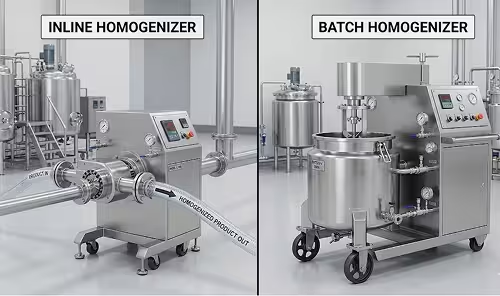
Inline homogenizer: Integrated into a continuous processing line. Milk or liquid flows continuously through the homogenizer between pasteurizer and packaging. No holding tank needed. Best for high-volume dairy, UHT, and beverage lines. Higher throughput, consistent output.

Batch homogenizer: Processes one batch at a time from a tank. Best for R&D, pilot-scale production, smaller dairy plants, and pharma formulation. Easier to adapt to multiple product types. Lower capital cost for small volumes.

Decision 4: Single-Stage vs Two-Stage Valve

Single-stage: One valve assembly. Achieves particle size 2–10 µm. Sufficient for standard milk, most beverages, and many pharma applications. Lower energy consumption. Higher throughput for same motor size.

Two-stage: Primary valve (size reduction) + secondary valve (particle distribution). Achieves <2 µm, sometimes sub-1 µm. Required for injectable pharmaceutical emulsions, premium UHT dairy, and cosmetic nanoemulsions. Higher energy cost. Essential where tight particle size distribution is specified.

Decision 5: Certifications Required

In India, certifications are not optional for regulated industries:

  • IS 13688: Mandatory for milk homogenizers under FSSAI-licensed dairy operations. Check your supplier has manufacturing certification, not just a declaration.
  • API 674: Required for homogenizer pump ends in pharma and chemical applications where positive displacement pump standards are specified.
  • FSSAI food-grade construction: SS304/SS316L wetted parts, food-safe lubricants. Required for all food and dairy equipment.
  • cGMP: For pharma, demand electropolished SS316L (Ra ≤0.8 µm), CIP/SIP design, and IQ/OQ documentation.

How to Evaluate Indian Homogenizer Suppliers

1. Ask for the factory test report. Every unit should be pressure-tested before dispatch. If a supplier cannot provide a pressure test certificate, that is a red flag.

2. Verify the certification is current. IS 13688 certification must be held by the manufacturer, not just claimed. Ask for the certificate number and verify it is not expired.

3. Check spare parts availability. A 5,000 LPH dairy homogenizer stopping for 3 days because a seal kit is unavailable costs more than the machine. Confirm the supplier stocks plunger seals, valve kits, and pressure relief valves in India.

4. Ask about commissioning support. Will the supplier send an engineer to your plant for commissioning? Is there an AMC option? A homogenizer is complex machinery — remote-only support is not adequate for first installation.

5. Understand the power-end warranty. Pump ends and power ends are the most expensive assemblies. Understand what the warranty covers, duration, and response time for warranty claims before you sign.

Conclusion — Homogenizer Buying Checklist

  • ☐ Capacity sized at 110–120% of peak line speed
  • ☐ Pressure matched to product requirement (not maximum available)
  • ☐ Inline or batch configuration confirmed
  • ☐ Single or two-stage valve selected based on particle size requirement
  • ☐ IS 13688 / API 674 / cGMP certification confirmed and current
  • ☐ Factory pressure test report requested
  • ☐ Spare parts availability in India confirmed
  • ☐ Commissioning support and AMC terms agreed

Need help specifying a homogenizer for your dairy, pharma, or beverage plant in India? Contact System Engineering Works, Nashik.
Phone: +91 9226622716  |  Email: info@systemengg.com

Frequently Asked Questions

Q: How do I choose the right homogenizer capacity for my dairy plant?
A: Size at 110–120% of peak line capacity. If your pasteurizer peak flow is 3,000 LPH, specify a 3,300–3,600 LPH homogenizer. Running at 100% continuously accelerates seal and valve wear.

Q: What is the difference between a single-stage and two-stage homogenizer?
A: Single-stage: one valve, achieves 2–10 µm particle size, lower energy use. Two-stage: primary + secondary valve, achieves sub-2 µm, required for injectable pharma emulsions and premium UHT dairy.

Q: Is IS 13688 certification mandatory for dairy homogenizers in India?
A: Yes. Under FSSAI licensing, milk homogenizers must meet IS 13688 standard. Manufacturers should hold IS 13688 certification. Request the certificate number and verify it is current before purchase.

Q: What pressure should I specify for a milk homogenizer?
A: Standard toned or full-fat milk: 150–200 bar. UHT/long-life dairy: 200–300 bar. Higher pressure increases energy cost. Match pressure to your product spec, not supplier maximum.

Q: Should I choose inline or batch homogenization for my food plant?
A: Inline for continuous production lines (dairy, UHT, large beverage). Batch for R&D, pilot scale, smaller plants, or multi-product facilities where flexibility matters more than throughput.

Q: Which homogenizer manufacturer in India has IS 13688 certification?
A: System Engineering Works (SEW), Nashik, manufactures IS 13688 certified dairy homogenizers. Capacity 100 LPH to 10,000 LPH. Call +91 9226622716 for specifications and pricing.

Related Feeds:

Have a specific requirement?

Talk to our engineering team. 22 years manufacturing homogenizers and triplex pumps in Nashik, 2,500+ units delivered pan-India.

Request a Quote from SEW

Get a Custom Quote

×
Thank you! Your submission has been received!
Oops! Something went wrong while submitting the form.