How to Spec a Homogenizer for Your Ice Cream or Dairy Plant

To specify a homogenizer for a dairy or ice cream plant: determine your required flow rate in LPH based on daily production volume, specify operating pressure (150–250 kg/cm² for dairy), choose 1-stage or 2-stage, confirm MOC (SS 304 or SS 316), and verify CIP compatibility. SEW TITAN Series covers 100 LPH to 5,000 LPH.

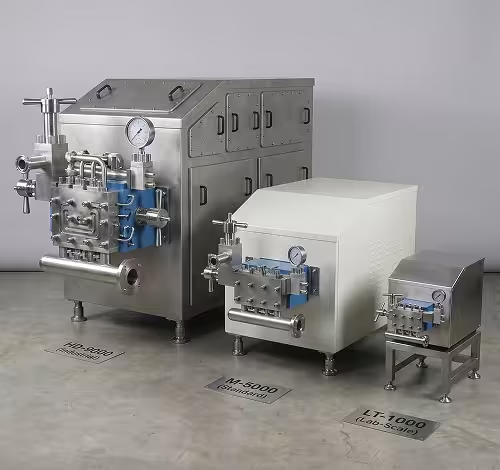
Different sizes and capacity of homogenizers manufactured by System Engineering Works, Nashik

Step 1: Determine Your Required Flow Rate (LPH)

Your homogenizer must process your full daily production volume within your available operating window — typically one shift (8 hours) less cleaning and changeover time (1.5–2 hours), giving approximately 6 effective processing hours per day.

Formula: Required LPH = Daily production volume (litres) ÷ effective processing hours per day

Example: A 3,000 LPD dairy plant with 6 effective hours needs a minimum 500 LPH homogenizer. SEW recommends sizing 10–15% above the calculated minimum to allow for production growth.

Daily ProductionEffective HoursMin. Homogenizer Size
500 LPD6 hrs~85 LPH → 100 LPH unit
3,000 LPD6 hrs~500 LPH (SHM-500)
6,000 LPD6 hrs~1,000 LPH
15,000 LPD6 hrs~2,500 LPH
30,000 LPD6 hrs~5,000 LPH

Step 2: Specify the Operating Pressure

Required homogenisation pressure depends on the product and the target fat globule size:

ProductFirst Stage (kg/cm²)Second Stage (kg/cm²)
Standard pasteurised milk150–17530–50
UHT milk175–20030–50
Ice cream mix200–25030–60
Cream (high-fat)100–15020–40
Juice / beverage100–15020–40

SEW TITAN Series operates at 2,000–3,000 PSI (140–210 kg/cm²), covering standard dairy and food processing requirements.

Step 3: Choose the Number of Stages

1-stage: Suitable for juices, beverages, and applications where basic emulsification (not sub-micron fat reduction) is sufficient.

2-stage (recommended for dairy): The second stage at 30–50 kg/cm² prevents re-clustering of fat globules after primary break-up. Required for IS 13688-compliant milk processing and ice cream with premium mouthfeel.

Step 4: Specify the Material of Construction (MOC)

  • SS 304: Standard for milk, cream, and neutral-pH food products
  • SS 316: Required for acidic products (fruit juices, fermented products) or aggressive CIP cleaning chemicals (nitric acid, peracetic acid)

SEW TITAN homogenizers use SS 304 / SS 316 construction with 22mm Tungsten Carbide Coated pistons.

Step 5: Confirm Power and Utilities

CapacityApproximate Motor Power
100–200 LPH1.5–5 HP
500 LPH7.5 HP
1,000 LPH15–20 HP
2,500 LPH30–40 HP
5,000 LPH50 HP

All SEW TITAN homogenizers are supplied with Hindustan Motors (or equivalent Indian-brand) motor as standard. Confirm your site's available power (voltage, phase) before ordering.

Step 6: Confirm CIP Compatibility

If your plant uses CIP (Clean-in-Place), confirm that the homogenizer is CIP-compatible — meaning all internal passages can be reached by cleaning solution without disassembly, and all wetted materials resist your CIP chemicals (caustic soda NaOH and nitric acid HNO₃ are standard in dairy). SEW TITAN Series homogenizers are designed for CIP operations.

Frequently Asked Questions

Can SEW supply a homogenizer for a turnkey ice cream plant?

Yes. SEW supplies complete turnkey ice cream plants including the homogenizer, pasteurisation tank, ageing vat, PHE cooler, centrifugal pump, SS piping, and commissioning. Contact SEW with your daily capacity requirement for a full project quotation.

What is a realistic budget for a 500 LPH dairy homogenizer in India?

SEW quotes on a project basis — pricing depends on capacity, pressure rating, MOC, motor specification, and accessories. Contact SEW with your full specification for a formal quotation. Standard delivery is 3–6 weeks from PO and advance payment receipt.

How do I know if I need a homogenizer or a high shear mixer?

For commercial milk sale in India, a high-pressure homogenizer (IS 13688-compliant) is required — a high shear mixer cannot achieve the required fat globule reduction. For sauces, dressings, or beverages where sub-micron emulsification is not required, a high shear mixer may be sufficient. Contact SEW with your product specification and we will recommend the appropriate equipment.

Does SEW manufacture homogenizers in Nashik?

Yes. SEW manufactures the TITAN Series at our own facility at Plot W-160, M.I.D.C. Ambad, Nashik, Maharashtra — ISO 9001:2000 certified by TUV SUD. All units are built to order at your exact specification, not catalogue items pulled from stock.

Have a specific requirement?

Talk to our engineering team. 22 years manufacturing homogenizers and triplex pumps in Nashik. 2,500+ units delivered pan-India.

Request a Quote from SEW

Get a Custom Quote

×
Thank you! Your submission has been received!
Oops! Something went wrong while submitting the form.

Get a Custom Quote

×
Thank you! We will be in touch shortly.
Thank you! Your submission has been received!
Oops! Something went wrong while submitting the form.