Answer First: When Should a Dairy Plant Choose an HTST Pasteurizer?
A dairy plant should choose an HTST pasteurizer when it needs continuous processing, controlled holding time, faster heating and cooling, better heat recovery, and consistent product safety across multiple production shifts. For commercial milk, flavored milk, dairy beverages, and high-volume ice cream mix preparation, HTST is usually the more scalable choice than heating one batch at a time.
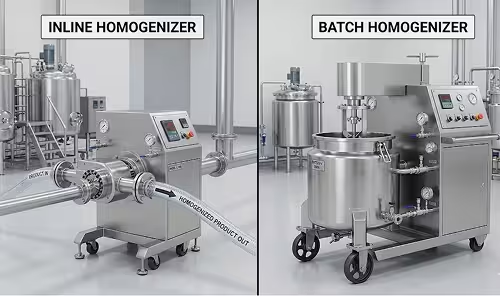
The decision is not only about buying a pasteurizer machine. The real question is whether your full line can support the selected litres per hour. The heat exchanger, holding tube, balance tank, homogenizer, pumps, cooling section, control panel, CIP circuit, and packaging line must all match the same operating capacity.
What an HTST Pasteurizer Does in a Dairy Plant
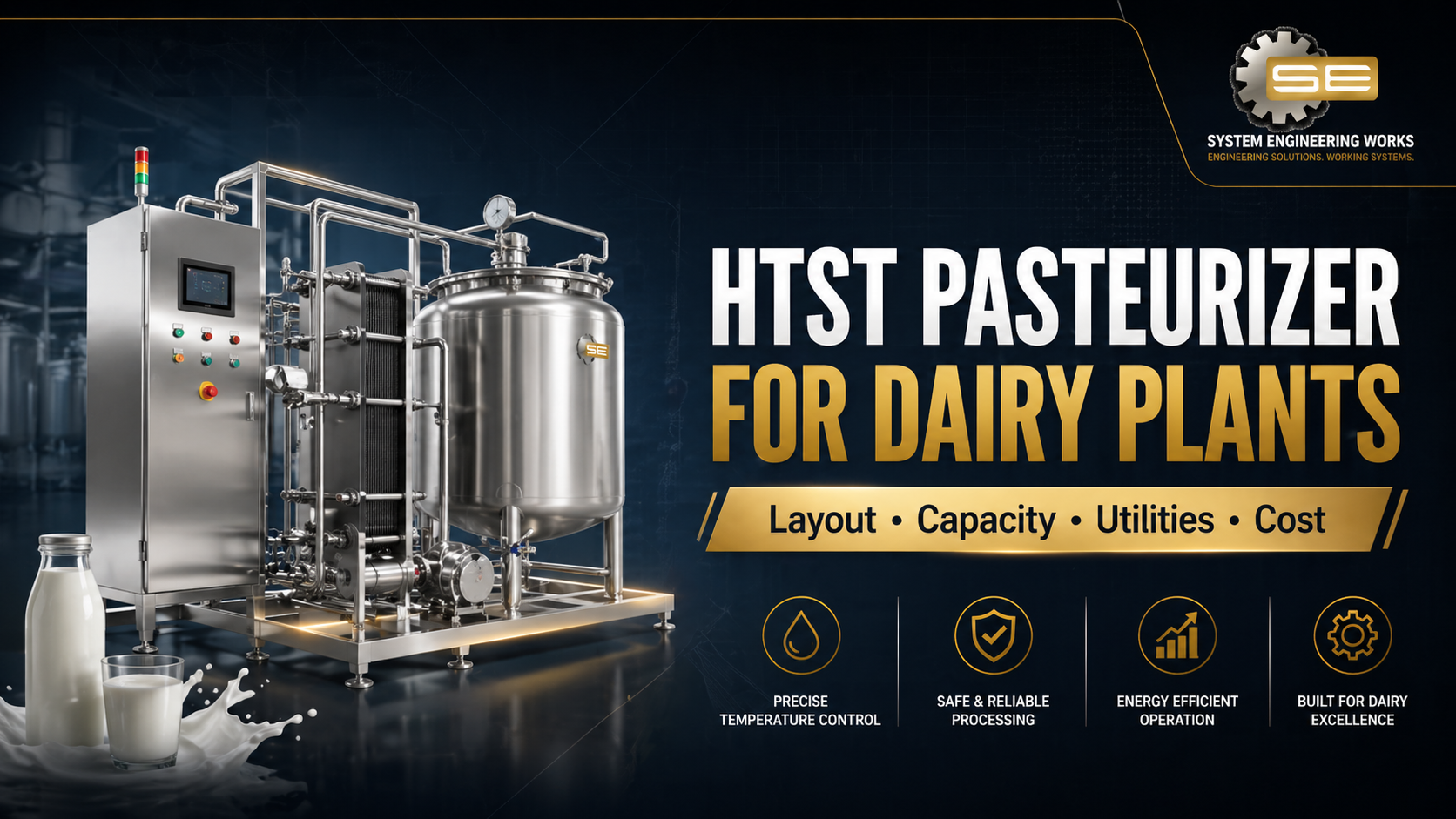
HTST stands for high temperature short time. Milk or dairy liquid is heated rapidly to the required pasteurization temperature, held for the required time, and cooled rapidly before storage or packing. A plate heat exchanger usually handles heat transfer, while a holding tube provides the validated residence time.
Capacity Planning: LPH Comes Before Price
The first specification is capacity in LPH. Do not select capacity only from daily production volume. Work backward from the number of effective processing hours available after CIP, startup, product changeover, and shutdown.
| Daily Milk Volume | Effective Processing Time | Indicative HTST Capacity |
|---|---|---|
| 5,000 litres/day | 5-6 hours | 1,000 LPH |
| 15,000 litres/day | 5-6 hours | 3,000 LPH |
| 25,000 litres/day | 5-6 hours | 5,000 LPH |
| 50,000 litres/day | 6-8 hours | 8,000-10,000 LPH |
Layout and Footprint Requirements
An HTST line needs space not just for the skid, but for operator access, service clearance, CIP connections, drains, electrical panels, and future expansion. Before finalizing layout, confirm product inlet and outlet direction, drain slope, tank positions, homogenizer location, chilled water path, and packaging room access.
Utilities That Affect Operating Cost
- Steam or hot water: required for heating the product to pasteurization temperature.
- Chilled water or glycol: required for rapid cooling after holding.
- Electric power: needed for pumps, controls, automation, and supporting equipment.
- Compressed air: required when pneumatic valves and flow diversion systems are used.
- CIP chemicals: caustic and acid cleaning cycles must be compatible with the line design.
Cost Factors Buyers Should Compare
The price of an HTST pasteurizer depends on capacity, heat exchanger surface area, automation level, holding tube design, valve package, MOC, controls, installation scope, and documentation requirements. A lower initial quote can become expensive if it has weak heat recovery, limited automation, poor service access, or undersized cooling.
Request a Quote from SEW with your LPH target, product type, heating source, cooling source, and available floor space. SEW can help map an HTST line around practical Indian dairy plant conditions.