Demand Signal Behind This Page
Queries related to dairy homogenizer, homogenizer for ice cream, and homogenizer machine for milk show recurring search intent. Buyers are not only asking for equipment names; they are asking for application fit and output consistency.
Why Flavored Milk and Lassi Need Application-Specific Setup
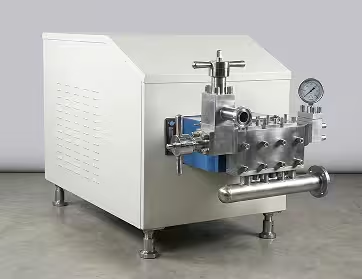
These products face phase separation risk, viscosity variation, and mouthfeel inconsistency when pressure bands are selected generically. A sanitary high-pressure homogenizer should be selected by recipe behavior, not only by LPH number.
Selection Framework for Dairy Beverage Plants
- Product profile: fat %, total solids, stabilizer system, and temperature window.
- Throughput target: current and peak-hour demand, plus growth headroom.
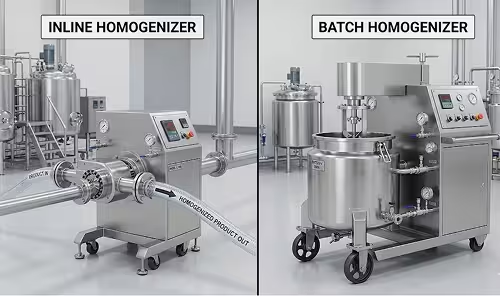
- Pressure strategy: one-stage vs two-stage based on texture and stability goals.
- Cleaning integration: CIP compatibility and hygienic changeover requirements.
Where Plants Usually Go Wrong
- Selecting capacity without considering downstream bottlenecks.
- Using a fixed pressure recipe for changing product formulations.
- Skipping validation runs at actual production conditions.
What SEW Provides
SEW supports model shortlisting, pressure-window validation, and commissioning guidance for flavored milk and lassi lines so plant teams can stabilize quality faster after startup.
Share These Inputs for a Model Recommendation
Product type, viscosity range, solids behavior, planned LPH, shift pattern, and city. This enables a realistic recommendation instead of a catalog-only suggestion.