Answer First: What Does Pasteurization Equipment Maintenance Include?
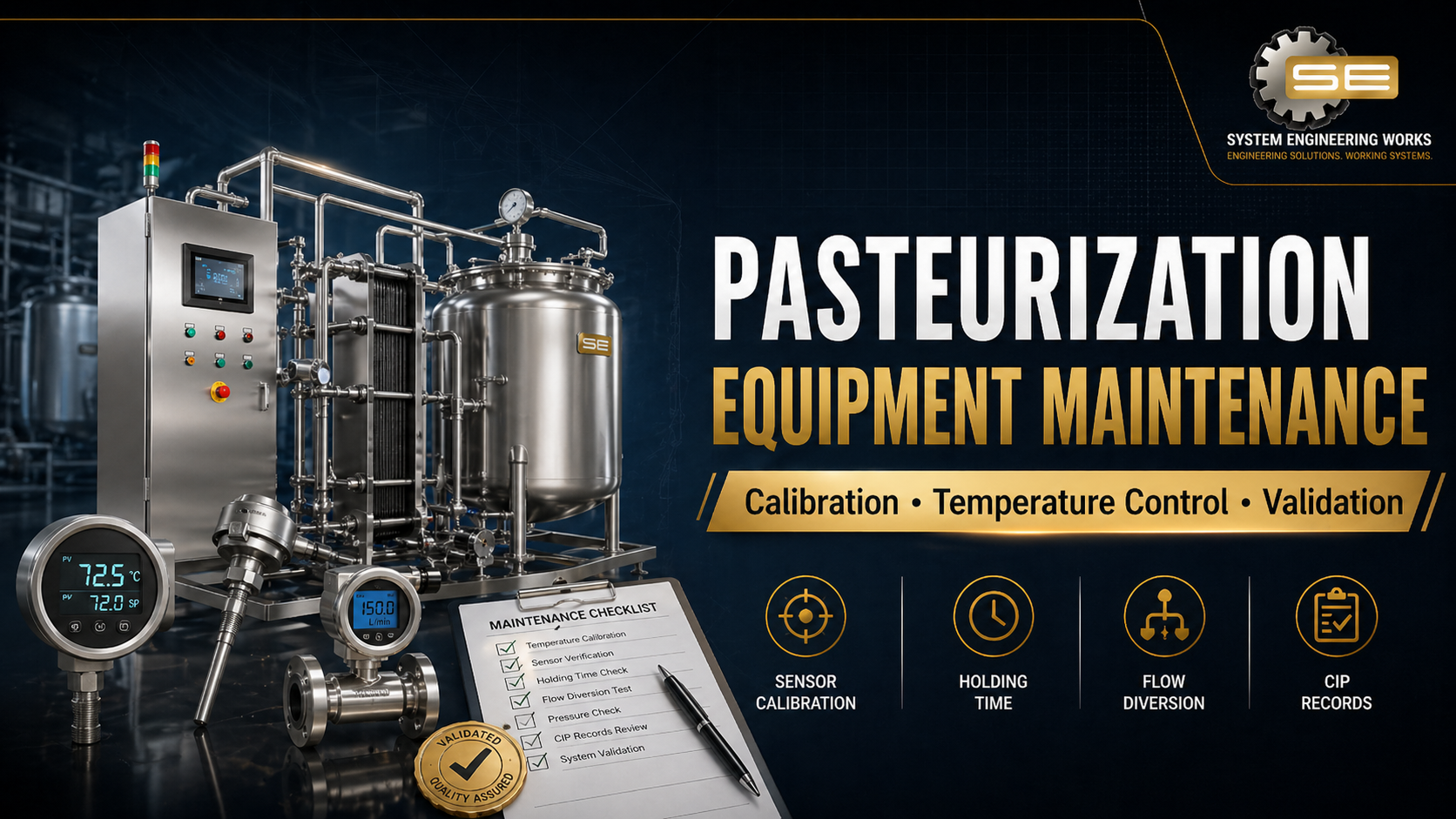
Pasteurization equipment maintenance includes temperature calibration, holding time verification, flow diversion checks, valve inspection, pump inspection, heat exchanger performance review, gasket condition, CIP effectiveness, control-panel review, and documentation. The goal is to keep product safe, stable, and audit-ready.
Why Maintenance Is a Food Safety Issue
Pasteurization is a safety-critical process. If sensors read incorrectly, holding time is inadequate, or flow diversion fails, the plant may believe the product is safe when actual processing conditions were not met.
Critical Areas to Inspect
- Temperature sensors: calibration and response time.
- Holding tube: correct residence time at required flow.
- Flow diversion: proper operation during low-temperature events.
- Heat exchanger: fouling, leaks, gasket condition, and pressure drop.
- Pumps and valves: flow stability and leakage.
- CIP circuit: cleaning coverage, drainability, chemical contact, and temperature.
Signs Your Pasteurizer Needs Service
| Symptom | Possible Cause |
|---|---|
| Longer heating time | Fouled heat exchanger or utility issue |
| Temperature fluctuation | Control, sensor, steam, or valve issue |
| Cooling delay | Chilled water/glycol issue or exchanger fouling |
| Frequent alarms | Control instability or sensor fault |
| High utility cost | Poor heat recovery or fouling |
Calibration and Validation
Calibration checks whether instruments are accurate. Validation checks whether the process achieves the required outcome. Both matter for product safety and audit confidence.
Request a Quote from SEW for pasteurization equipment maintenance or line review.