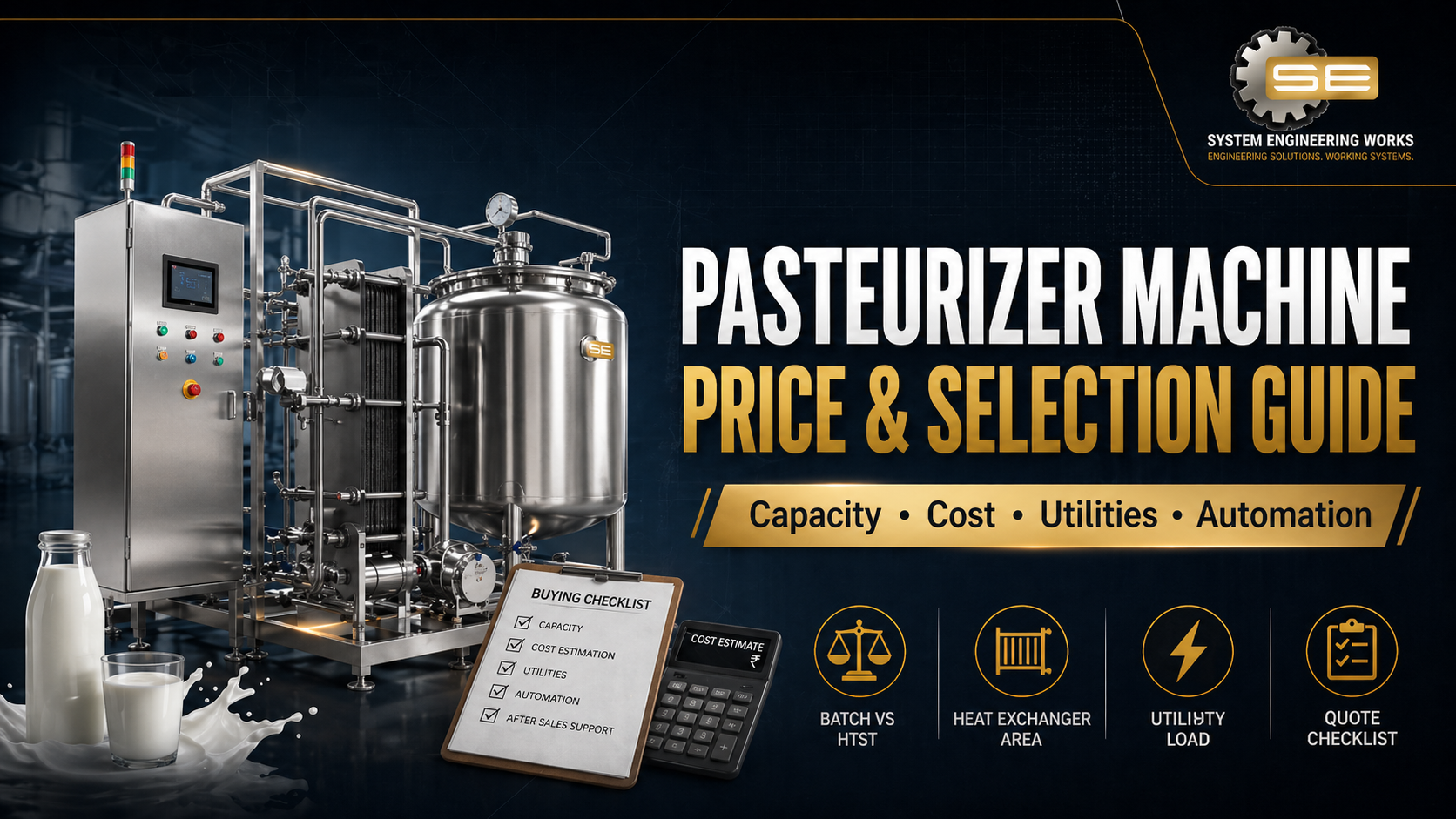
Answer First: What Decides Pasteurizer Machine Price?
Pasteurizer machine price is decided by capacity, batch vs HTST design, material of construction, heat exchanger area, heating and cooling utilities, automation level, valves, controls, installation scope, and documentation. A low quote is not always the lowest-cost solution if it consumes more steam, cools slowly, or causes downtime.
Batch vs HTST Cost Difference
Batch pasteurizers are usually simpler and lower cost for small plants. HTST pasteurizers cost more upfront but support continuous production, better heat recovery, and higher throughput. The correct choice depends on daily volume and production pattern.
| Plant Situation | Likely Better Fit | Why |
|---|---|---|
| Low daily volume | Batch pasteurizer | Lower capital cost and flexible operation |
| Multiple products | Batch pasteurizer | Easier SKU flexibility |
| Packaged milk at scale | HTST pasteurizer | Continuous throughput and heat recovery |
| High utility sensitivity | HTST pasteurizer | Better energy efficiency when sized correctly |
Capacity Drives Most of the Budget
A 200-litre batch unit and a 5,000 LPH HTST line are not comparable. Buyers should define litres per batch or litres per hour before asking for price. Without capacity, suppliers cannot correctly size heating, cooling, pumps, valves, or control systems.
Hidden Cost Factors
- Heat recovery: better recovery reduces operating cost.
- Automation: improves repeatability and reduces operator dependency.
- CIP design: affects cleaning time, chemical use, and hygiene.
- Service access: reduces downtime during maintenance.
- Documentation: useful for audits, institutional buyers, and regulated production.
How to Compare Quotes Fairly
Ask every supplier to quote the same product, capacity, MOC, automation level, heating source, cooling source, and installation scope. Then compare operating cost, warranty, service response, spare parts, and commissioning support.
Request a Quote from SEW with product type, required capacity, heating source, cooling source, and automation requirement.