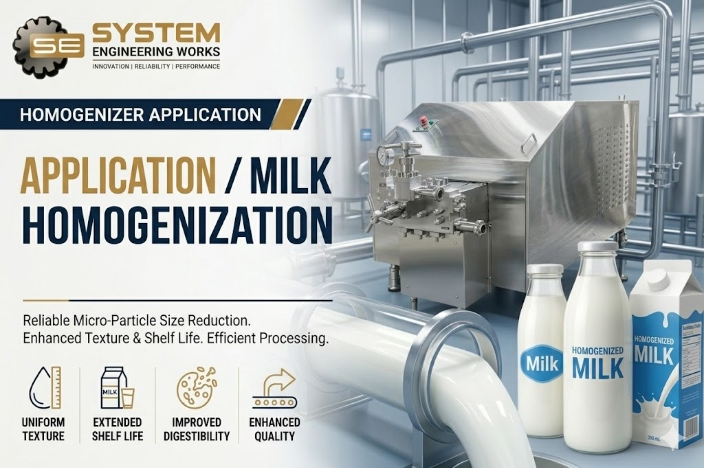
Milk Homogenization
Overview
Cream separation in packaged milk is the most visible quality defect Indian dairy processors face. A cream line at the top of a pouch or bottle signals to the consumer that the product is inconsistently processed — regardless of fat content or nutritional quality. FSSAI standards under FSSAI-FSS (Food Products Standards and Food Additives) Regulations require homogenized milk to show no visible cream separation when tested per IS 1479 (Part 2). Failing this standard risks product recall and FSSAI audit action.
SEW's Titan Series homogenizer reduces fat globule size to below 1 micron — the threshold below which globules remain stably dispersed in the milk serum under normal storage conditions — preventing cream line formation in pasteurised, standardised, and toned milk at capacities from 500 LPH to 5000 LPH.
How It Works
Pre-heated standardised milk (typically 60–70°C, 3.5% fat or as specified) is fed to the homogenizer under feed pressure from the balance tank. The Titan Series triplex pump raises milk pressure to 150–200 bar (first stage) and forces it through the homogenizing valve gap at high velocity. The combination of shear, turbulence, and cavitation breaks fat globules from 3–6 microns (raw milk) to below 1 micron — the same principle scaled up for ice cream mix homogenization. Second-stage valve at 30–50 bar prevents reagglomeration of broken globules. Homogenised milk exits to the pasteuriser or plate cooler.
Bare Unit Use
Dairy plant engineers and milk processing contractors order the bare homogenizer for integration between the balance tank and the pasteuriser, or between the pasteuriser and the plate cooler, depending on processing sequence. Available in 500 LPH to 5000 LPH capacity. SS 316L contact parts. Two-stage valve configuration standard for homogenized milk. Operating pressure: 150–200 bar (first stage) + 30–50 bar (second stage).
Skid Package Use
SEW supplies the homogenizer on a SS 304 skid with feed pump, pressure gauges, and inlet/outlet connections sized to line pipe specification. Used in: milk processing plants (dairies), co-operative dairy processing units, institutional milk supply chains, and school milk programme processing facilities across Maharashtra, Gujarat, Rajasthan, and Punjab — including plants near Anand.
Why SEW
Two-stage homogenization valve — first stage breaks fat globules to below 1 micron; second stage prevents reagglomeration. Meets IS 1479 cream separation test requirements.
FSSAI-compliant SS 316L food-grade contact parts — stainless steel wetted parts meet FSSAI Schedule 4 equipment hygiene requirements for milk processing.
500 LPH to 5000 LPH capacity range — covers small co-operative dairy plants (500–1000 LPH) to large processing facilities (3000–5000 LPH) in one product family.
Indian manufacturer, Nashik — Maharashtra dairy belt proximity, spare valve assemblies in stock, local service support in Bengaluru and Vadodara. No extended downtime in a high-throughput milk processing shift.
See full specifications on the SE-Titan HP Homogenizer product page.
Need help selecting the right equipment for your application?
Get in Touch →